Balancing Code Ownership and Automation: When Self-Writing Code Makes Sense
written by Alec Sherman | Published: February 12, 2026
Let's be honest. The term "self-writing code" gets thrown around in boardrooms and investor pitches like it's some kind of solved problem. The fantasy is a magical AI that intuits your business needs and spits out a flawless, enterprise-grade application. The reality, as any CTO who has survived a few hype cycles knows, is usually a restrictive, black-box no-code platform that works beautifully until the moment you need it to do something truly unique. Or secure. Or scalable.
This industry has created a false dichotomy. You're told to choose between the lightning-fast, drag-and-drop world of no-code platforms where you own nothing, or the plodding, expensive world of custom development where you're forever reinventing the wheel. You're forced to weigh development speed against the fundamental advantages of code ownership. I'm here to tell you that's a sucker's choice. The real goal isn't just automation; it's governed automation that produces code you actually own, control, and can build a business on for the next decade.
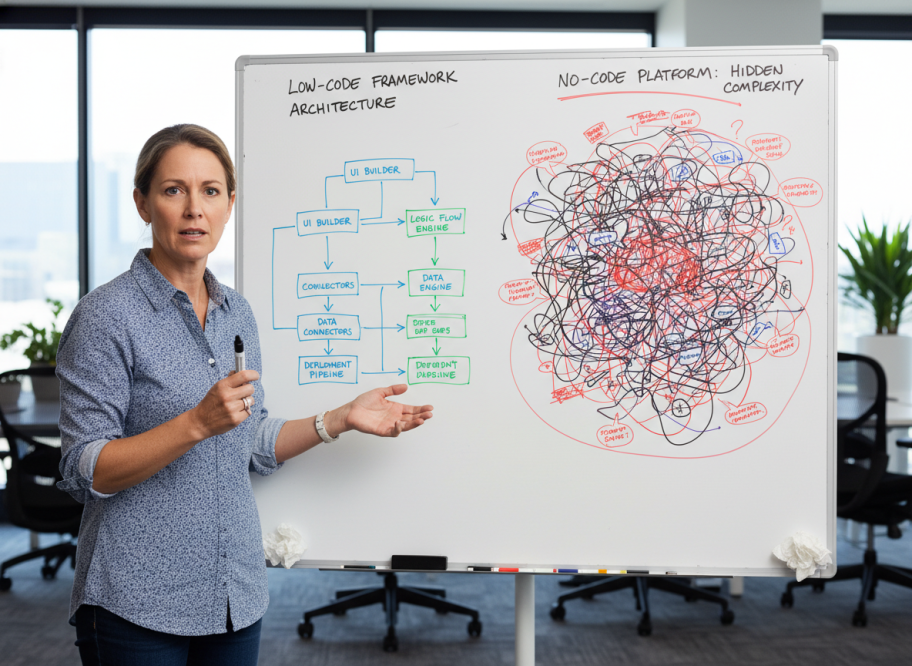
The Siren Song of "No-Code" and Its Inevitable Rocks
I've seen the demos. They're slick. In twenty minutes, a sales engineer builds a simple CRM that would take a junior dev a week. Management is impressed. Budgets are allocated. And for a while, everything seems great. You launch your MVP in record time. Then, the requests start coming in.
First, it's a request to integrate with a legacy accounting system that doesn't have a modern REST API. The no-code platform's pre-built connectors can't handle it. Then, a major client requires a specific data residency and security compliance report that your black-box vendor can't provide because you have no server control. Finally, the platform announces a new "per-user" pricing tier that will triple your operational costs overnight. You're trapped. Migrating off the platform would mean a complete, from-scratch rewrite. The speed you gained upfront has been paid for with a crippling long-term mortgage of technical debt and vendor lock-in. You don't have code ownership; you have a subscription to a service that dictates your technical capabilities.
The Grind of "All-Code" and the Tyranny of Boilerplate
On the other end of the spectrum is the purist's approach: build everything from the ground up. This grants you ultimate control, but at a staggering cost. Did you know that developers spend, on average, 40% of their time writing infrastructural code? That's nearly half their week spent not on the unique business logic that creates value, but on the same boilerplate they wrote at their last three jobs.
Think about it. How many authentication systems have you built? How many times have you designed a database schema for user management, with tables for login history, failed attempts, and role-based access control? How many basic CRUD (Create, Read, Update, Delete) interfaces have you wired up? This is the Sisyphean task of modern software development. It’s not just inefficient; it's soul-crushing for talented engineers who would rather be solving complex problems. This approach guarantees full ownership, but it also guarantees you'll be three times slower and 60% more expensive to maintain than you need to be.
The Pragmatic Compromise: Governed, Self-Writing Code
This is where we need to redefine "self-writing code." Forget the AI fantasy. Think of it as expert-system-driven code generation. This is the core philosophy behind a true low-code framework like Wizard's Toolkit. It's not about hiding the code from you; it's about automating the generation of the 40% of boilerplate so you can focus on the 60% that matters.
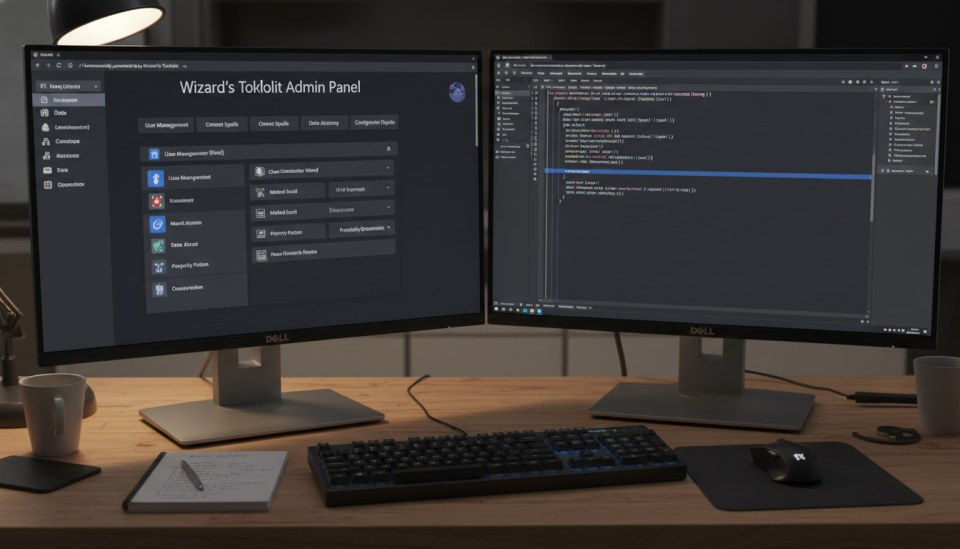
Consider our Page Builder. You don't drag and drop abstract components into a proprietary canvas. You go through a simple four-step process in the admin panel where you define your database details—the tables, the fields, the relationships. WTK then writes the actual, production-ready PHP files for you. The crucial difference is what happens next: those files are yours. You can open them in your IDE. They are clean, standardized, modern PHP 8.2+ code. You can modify them, extend them, add complex business logic, and commit them to your Git repository. This is the essence of automation with code ownership. You get the 10x acceleration of generating a feature in days instead of weeks, without sacrificing a single line of control. That's what effective self-writing code governance looks like in practice.
Achieving Scalable Software Development with Enterprise Software Architecture
This balance of automation and ownership isn't just a project-level decision; it's the foundation of a sound enterprise software architecture. When your automated tools produce real code, you unlock capabilities that are impossible with no-code platforms.
- True Scalability: Your application's performance is limited only by your infrastructure, not a vendor's multi-tenant architecture. When a database query needs optimization, you can write it yourself. When you need to add a microservice or integrate a complex third-party API, you have the full power of the PHP ecosystem at your disposal. You're building on a solid foundation, like our pre-configured tables for `wtkEcommerce` or `wtkReports`, not a fragile abstraction.
- Ironclad Security and Compliance: You can't audit a black box. With full code and server control, you can implement any security protocol, logging (`wtkLoginLog`, `wtkFailedAttempts`), or data handling policy required to meet standards like GDPR, HIPAA, or SOC 2. You control the environment, you control the code, you control your destiny during a security review.
- Long-Term Maintainability: No-code platforms often become a tangled mess of visual workflows that are impossible to debug. A low-code framework that generates consistent, conventional code makes maintenance and onboarding new developers dramatically simpler. Your codebase, from user management (`wtkUsers`) to custom modules, follows a predictable structure, reducing the cognitive load on your team and slashing long-term costs. This is how you build a scalable software development practice.
Conclusion: Your Job Is to Eliminate Waste, Not Code
As a technical leader, your objective should never be to simply write more code or less code. Your job is to deliver robust, secure, and scalable value to the business as efficiently as possible. The no-code movement correctly identifies the problem—that much of custom development is wasteful repetition—but offers the wrong solution in the form of a gilded cage.
The intelligent path forward is to embrace automation that serves you, not a vendor. Adopt tools that handle the undifferentiated heavy lifting of infrastructure, generating clean, maintainable code that you own completely. This allows your team to pour their expertise and creativity into the unique features that differentiate your business. That's not a compromise; it's just a smarter way to build software.

About Alec Sherman
Chief Technology Wizard - Alec has spent over a decade as a CTO, helping companies from the USA to Dubai modernize their technology. He built his first database at 14 and now focuses on implementing AI solutions.
Full Bio → | LinkedIn | GitHub