When to Let Code Write Code: Guardrails for Safe Automation
written by Alec Sherman | Published: January 13, 2026
Let’s be honest. The promise of “self-writing code” has been dangled in front of developers for decades, usually by someone trying to sell a platform that ends up being more restrictive than a straightjacket. The fantasy is a button you push that magically transforms a vague business requirement into a robust, scalable application. The reality, as any CTO who’s had to clean up the mess knows, is often a tangled web of unmaintainable, auto-generated garbage.
But the dream isn't entirely dead. It’s just been misunderstood. The goal isn’t to have a machine think for you; it's to have a machine handle the tedious, repetitive work that you’ve already figured out a dozen times. This isn't artificial intelligence, it's intelligent automation. The difference is crucial, and it’s protected by one thing: guardrails. Without them, you’re not accelerating development; you’re accelerating technical debt.
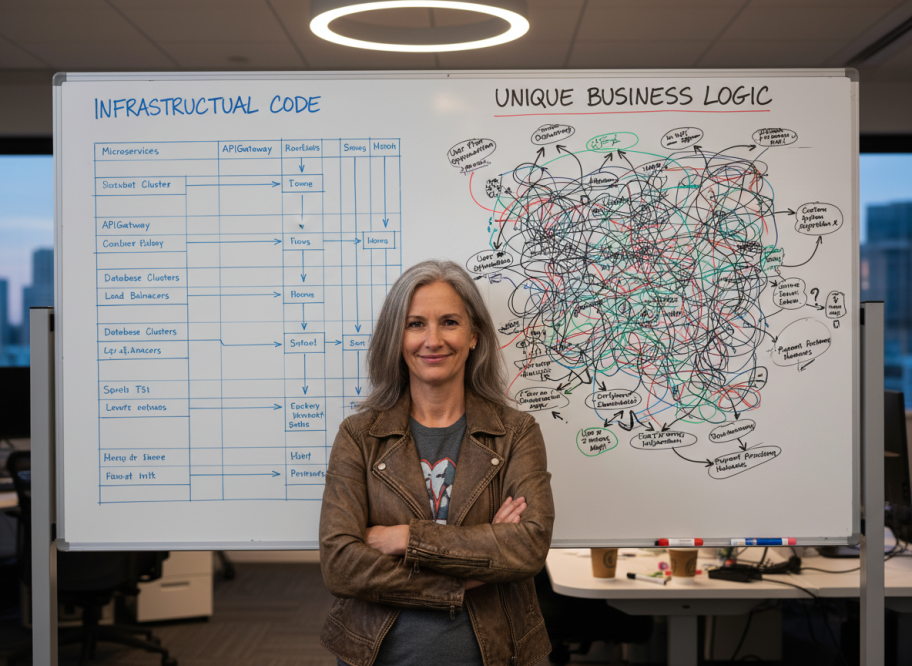
The uncomfortable truth of enterprise software development is that a huge chunk of our time is spent onsolved problems. Industry data, and my own scar tissue, suggests that up to 40% of development effort is burned on pure infrastructure: authentication, session handling, basic CRUD (Create, Read, Update, Delete) forms, logging, and user management. It’s the digital equivalent of laying plumbing and electrical wiring in every new house. It’s essential, non-negotiable, and utterly devoid of business innovation.
This is the fertile ground for automation. This is where you should let code write code. Why? Because these tasks are all based on well-defined, repeatable patterns. The logic for verifying a password hash or paginating a list of users doesn’t change dramatically from one project to the next. Manually coding this foundational layer is not only slow, it’s an invitation for human error—a forgotten security header here, an inconsistent naming convention there. A good code generator executes these patterns flawlessly, every single time.
The Scaffold vs. The Architecture
Think of it like this: a powerful automation tool builds the scaffold. It erects a perfectly standard, secure, and stable structure based on proven engineering principles. At Wizard's Toolkit, our Page Builder does exactly this. You define the database details, and it generates the production-ready PHP files to manage that data. It’s not trying to guess your business logic; it’s giving you the robust framework—the forms, the data grids, the server-side handlers—so you can focus on building the unique architecture inside that scaffold.
Guardrails for Automated Coding: Staying Off the Hype Train
So, how do you harness this power without driving your project off a cliff? You need strict, non-negotiable rules. These are the guardrails that separate professional enterprise software automation from toys that create brittle, one-off MVPs.
Guardrail 1: Automate the Pattern, Not the Unique Logic
This is the most critical distinction. A pattern is a repeatable solution to a common problem. Generating a user administration module from a `wtkUsers` table is a pattern. Generating the specific, multi-step approval workflow for a new user in a regulated industry is unique business logic. Your automation tool should handle the first, and get out of the way for the second. The moment a code generator starts making assumptions about your core business rules, you’ve lost control.
Guardrail 2: The Output Must Be Human-Readable and Maintainable
If you can't read the code, you don't own it. This is the fundamental flaw of most no-code platforms. They give you a black box. When you hit a limitation—and you will always hit a limitation—you have no recourse. Safe automation generates clean, conventional, human-readable code. It should look like code a senior developer would write: well-formatted, logically structured, and devoid of magic. The goal is to reduce a 10,000-line feature to 2,000 lines of *your* code, not to hide all 10,000 lines behind a proprietary API.
Guardrail 3: Convention Over Configuration
Automation thrives on predictability. A solid framework establishes strong conventions for everything from database table naming to file structure. When the generator knows that `wtkUsers` will always have a primary key named `id` and a field for the last login, it can produce consistent, reliable code. This enforced consistency is a godsend for long-term maintenance, drastically reducing the 60% higher costs associated with cleaning up bespoke, inconsistent codebases. It’s about making smart, system-wide decisions upfront so the automation can run smoothly.
When to Use Automated Code (And When to Back Away Slowly)
Knowing the right tool for the job is half the battle. Just because you *can* generate something doesn't mean you *should*. Here’s a simple field guide for applying self-writing code safety.

The Green Lights: Full Speed Ahead
- CRUD Interfaces: This is the absolute sweet spot. If your feature is primarily about managing data in a database table, it should be 90% generated.
- Authentication and User Management: It's a solved problem. Generating the login forms, password reset flows, and role-based access controls from a pre-configured system like WTK’s is not just faster, it's more secure than rolling your own for the twentieth time.
- Standard API Endpoints: Generating the boilerplate for RESTful endpoints to expose your data is a massive time-saver. Let the machine write the routing, request handling, and response formatting.
- Dashboards and Reporting Widgets: The initial setup of charts, graphs, and data tables is a perfect task for automation. You can then focus on fine-tuning the complex SQL queries behind them.
The Red Flags: Danger Ahead
- Core Differentiating Business Logic: This is your company's secret sauce. It's complex, nuanced, and unique to you. This code should be crafted by your best developers, not a generator.
- Highly Novel or Experimental UI/UX: If you're building a user interface that breaks all existing paradigms, a generator based on standard patterns will only frustrate you.
- Complex Third-Party Integrations: The glue code needed to communicate with a legacy system or a poorly documented third-party API is almost always a custom job requiring careful, manual implementation.
Conclusion: It's About Augmentation, Not Replacement
Effective code automation isn’t about replacing developers. It’s about elevating them. It’s about taking away the 40% of their job that is drudgery so they can pour their full intellect into the complex problems that actually drive business value. By establishing clear guardrails—automating patterns, demanding readable output, and enforcing conventions—you can transform code generation from a risky gimmick into a strategic advantage.
The ultimate payoff isn't just launching an MVP in five days instead of six weeks. It's building a scalable, maintainable, and sane enterprise application where your best minds are free to solve tomorrow's problems instead of re-solving yesterday’s.

About Alec Sherman
Chief Technology Wizard - Alec has spent over a decade as a CTO, helping companies from the USA to Dubai modernize their technology. He built his first database at 14 and now focuses on implementing AI solutions.
Full Bio → | LinkedIn | GitHub