Extending and Integrating Low-Code PHP Libraries: Plugins, Hooks, and Custom Business Rules
written by Alec Sherman | Published: January 14, 2026
Let’s be honest. The initial demo of any low-code platform is intoxicating. You drag, you drop, you connect a few boxes, and suddenly you have a user login form that looks passably modern. You feel like a genius. You’ve just built in an afternoon what used to take a week of wrangling authentication libraries and CSS. And then, reality sets in. The client asks for something deceptively simple: “Can we add a two-factor authentication step that uses our in-house SMS gateway?” or “We need to run a custom credit check through a third-party SOAP API every time a new user from Germany signs up.”
Suddenly, the drag-and-drop paradise becomes a prison. You’re digging through obscure documentation, begging on community forums, and realizing the platform’s “extensibility” is limited to a pre-approved list of Zapier integrations. The 80% you built in a day is now blocked by a 20% problem that feels impossible. This is the low-code ceiling, and if you’re a serious developer, you’ve probably smashed your head against it more than once.

The fundamental flaw in many of these platforms isn’t the concept; it’s the architecture. They are closed-box services designed to keep you inside their ecosystem. True extensibility requires something they can never give you: ownership of the code and the server. It requires a framework, not a rental.
When “Rapid” Becomes “Rigid”: The Integration Wall
The sales pitch for no-code is that it abstracts away the complexity of code. The unfortunate side effect is that it also abstracts away your power. When you need to implement custom business rules that aren't covered by a pre-built widget, you’re stuck. Need to integrate with a legacy system that doesn't have a neat REST API? Good luck. Want to optimize a database query that’s running slow under heavy load? You can’t even see the query, let alone index the tables.
This is where a low-code *framework* like Wizard's Toolkit fundamentally changes the game. We operate on a simple principle: automate the tedious, but empower the complex. We’ll save you that 40% of time typically wasted on infrastructural code—building auth systems, session management, dashboard scaffolding, and CRUD interfaces from scratch. We provide over 30 pre-configured, optimized database tables for everything from e-commerce (`wtkEcommerce`) to user management (`wtkUsers`). But we also give you the keys. It’s your PHP, your SQL, and your server. When you hit that 20% wall, you don’t have to find a workaround; you just write the code.
Practical Extensibility: Hooks, APIs, and Raw SQL
Let's move from the philosophical to the practical. How do you actually extend a system when your business logic is more nuanced than an IF/THEN statement in a visual builder? You use the same powerful techniques professional developers have used for decades, just without the initial boilerplate.
Hooks and Event Listeners: The Polite Interruption
A good framework is littered with hooks. These are designated points in the code's execution lifecycle where you can inject your own logic. Instead of modifying the core files (a cardinal sin of framework development), you simply "listen" for an event and execute your custom function.
Imagine your application has strict requirements for user quality. You need to ensure every new user has a professional, deliverable email address at signup, and you want to automatically enrich their profile with available public data to personalize their onboarding.
// Your custom business logic in a separate file (e.g., custom_hooks.php)
function validate_and_enrich_new_user($user_id) {
    // 1. Get the freshly created user's data
    $user_data = wtk_get_user($user_id);
    $user_email = $user_data['email'];

    // 2. Call a real email validation & enrichment API (e.g., Hunter.io)
    $api_response = call_hunter_verify_api($user_email);

    // 3. Critical Business Logic: Decide if the user is valid
    if ($api_response['status'] == 'valid' && $api_response['score'] > 70) {
        // Email is good! Enrich the user profile with found data
        wtk_update_user($user_id, [
            'company' => $api_response['company'] ?? null,
            'job_title' => $api_response['position'] ?? null,
            'data_source' => 'hunter_api'
        ]);

        // Tag them for a professional onboarding flow
        wtk_add_user_tag($user_id, 'professional_email_verified');

    } else {
        // Email is invalid, disposable, or too risky
        wtk_add_user_tag($user_id, 'needs_email_review');

        // Optionally, queue a notification for your admin team
        wtk_create_internal_alert('Potential Low-Quality Signup', $user_id);

        // The user account remains active, but is now flagged for follow-up
    }

    // 4. Log this verification attempt for compliance/analytics
    wtk_log_audit_event('email_verification', $user_id, $api_response);
}

// Attach our function to the precise moment we need it
wtk_add_hook('after_user_create_before_welcome', 'validate_and_enrich_new_user');
With Wizard's Toolkit's hook system, you're not rebuilding the user creation form. You write a focused function that runs immediately after the core framework creates the user record, but before the registration is finalized and the welcome email is sent.
The REST API and the Single Page Application (SPA)
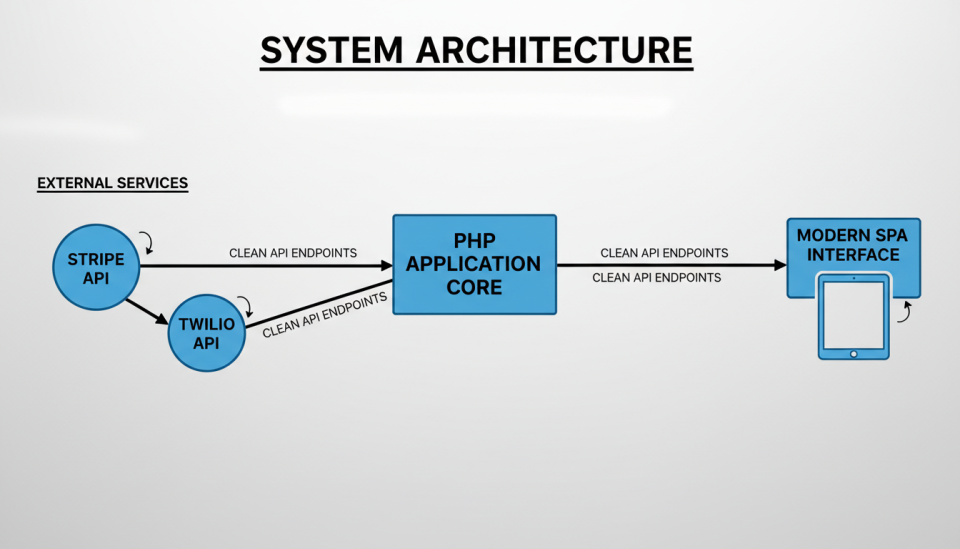
One of the most critical integration points for any modern application is its REST API. Your low-code backend shouldn't be a black hole of data. It needs to communicate with other services, mobile apps, and especially modern front-end frameworks like React or Vue.js. This is where the Single Page Application comes in.
A framework approach makes this trivial. Since you have full control over the PHP and the database (whether it's MySQL, PostgreSQL, etc.), you can create secure API endpoints for any data you manage. Wizard's Toolkit accelerates this by already having the database architecture and user authentication in place. You can build a robust, secure backend with a full admin panel in a few days. Then, you simply add a few PHP files to serve your data as JSON. Your front-end team can then build a beautiful, responsive SPA that consumes this API, without ever needing to touch the backend logic. You get the speed of low-code for the backend and the flexibility of a custom front-end, all communicating through a clean REST integration.
Direct SQL: The Ultimate Escape Hatch
Sometimes, an ORM or a data abstraction layer just gets in the way. Your marketing team needs a report that requires a complex, multi-table join with aggregate functions and windowing—the kind of query that would make a visual query builder cry. In a locked-down platform, this is impossible. In a framework, it’s just another Tuesday.
Because you have direct database access, you are never limited by the framework's data functions. You can write raw, optimized SQL to handle the most demanding reporting or data processing tasks. This is the ultimate escape hatch. It ensures that no matter how complex your business logic becomes, you will never be blocked by your tools. You can use the framework's generated pages for 95% of your CRUD operations and then write a highly optimized, custom SQL query for that critical financial report. That’s not a failure of low-code; it’s a sign of a mature, enterprise-ready system.
Conclusion: Low-Code Doesn't Have to Mean Low-Control
The goal of effective low-code isn't to eliminate code entirely; it's to eliminate *wasteful* code. It's about automating the repetitive, infrastructural tasks so that you, the developer, can focus your talent on the complex integrations and custom business rules that deliver real value.
The next time you evaluate a platform, don't just ask what you can build on day one. Ask what happens when your requirements get complicated. Ask about hooks, about direct database access, and about your ability to write a custom API endpoint. If the answer involves the words “workaround” or “professional services engagement,” you’re looking at a gilded cage. True acceleration comes from a framework that gives you a massive head start but still trusts you to take the wheel when the road gets rough.

About Alec Sherman
Chief Technology Wizard - Alec has spent over a decade as a CTO, helping companies from the USA to Dubai modernize their technology. He built his first database at 14 and now focuses on implementing AI solutions.
Full Bio → | LinkedIn | GitHub