From MVP to Enterprise: Leveraging Pre-configured Modules and APIs
written by Alec Sherman | Published: February 27, 2026
Let's be honest. The term "MVP" has been warped into a synonym for "disposable code." You're told to ship fast, break things, and find product-market fit. So you grab the nearest no-code platform or duct-tape together a few scripts, launch your Minimal Viable Product, and for a fleeting moment, you're a hero. Then reality hits. Your first real customer asks for a feature the platform doesn't support. Your user table lacks the fields for proper auditing. Your hardcoded Stripe integration needs to be ripped out to add PayPal. Suddenly, your "rapid MVP deployment" has morphed into a "total rewrite," and you're burning cash and developer hours to build the application you should have built in the first place.
The industry sells a false dichotomy: either build a clunky, unscalable MVP in a week with a no-code tool, or spend six months over-engineering an enterprise-grade monolith for ten users. Both paths lead to ruin. The first ends in a technical dead-end, the second in bankruptcy. The real solution lies in building an enterprise MVP architecture from day one—a foundation that supports immediate needs while being explicitly designed to scale. This isn't about building slowly; it's about building intelligently with pre-configured modules and a sane API strategy.

The Foundational Flaw: Why Your MVP Is Built to Fail
The pressure to launch is immense. I get it. But the tools promising instant gratification often build your gallows. No-code platforms are fantastic for validating a marketing concept, but they are not application development environments. You hit a ceiling the moment you need custom business logic, direct database access for reporting, or control over your security posture. You're renting, not owning, and the landlord can change the rules at any time.
On the other end of the spectrum is the team that decides to build everything from scratch in Node.js or Python. They spend 40% of their initial sprint—weeks of valuable time—on boilerplate. User authentication, session management, password hashing, logging, and basic user profile tables. This is infrastructural code, the solved problems of web development. Writing it yourself in 2024 is like insisting on forging your own nails to build a house. It's artisanal, expensive, and utterly pointless. You're not paid to write a login form; you're paid to solve a unique business problem. Every hour spent on boilerplate is an hour not spent on the features that actually generate revenue.
Start with a Skeleton, Not a Sculpture: The Power of Pre-configured Modules
A smarter approach is to begin with a robust, enterprise-ready skeleton. This is where `pre-configured modules for MVP` become your most significant strategic advantage. Instead of an empty directory, you start with a low-code framework that provides the non-negotiable foundations of any serious application. Think of it as a professional-grade chassis for your custom-built engine.
For instance, at Wizard's Toolkit, we don't give you a blank slate. We give you over 30 pre-built, optimized database tables out of the box. You get:
- User Management: `wtkUsers`, `wtkUserHistory`, `wtkLoginLog`, and `wtkFailedAttempts`. This isn't just a `users` table; it's a complete, secure authentication and auditing system.
- E-commerce: `wtkEcommerce`, `wtkRevenue`, and `wtkInboundLog`. Ready to handle transactions and reporting without you writing a single line of schema.
- Communications: `wtkChat`, `wtkNotifications`, and `wtkEmailsSent`. The plumbing for user engagement is already laid.
Using a system like this for `rapid MVP deployment` means you skip the entire infrastructural phase. You use a visual page builder to define your database needs, and it generates the production-ready PHP files. Your focus immediately shifts from "How do I securely store a password?" to "What is the core business logic for this feature?" You're not sacrificing quality for speed; you're leveraging battle-tested, pre-built components to achieve both. Your MVP, built on this foundation, shares the same DNA as the enterprise application it will become.
Enterprise MVP Architecture: Beyond the Prototype with API Integration
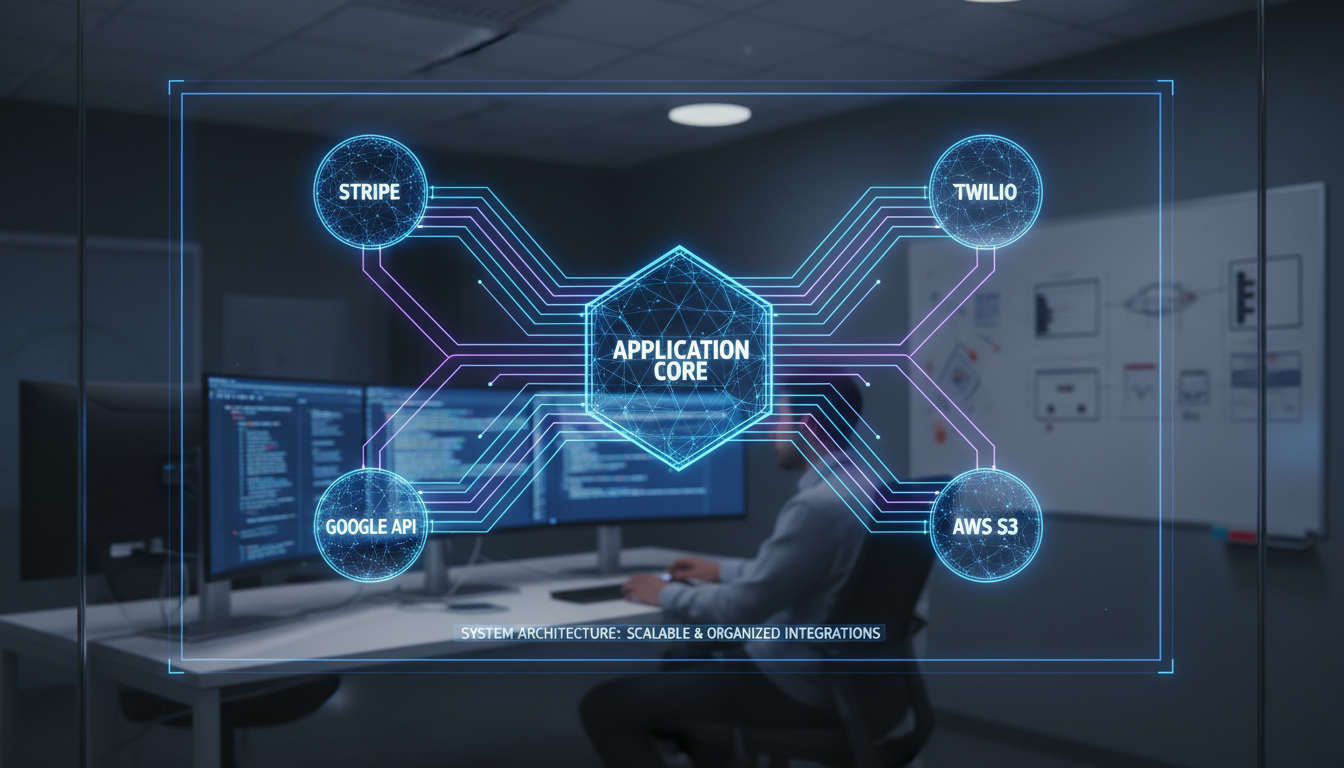
An application is not an island. Even the leanest MVP needs to communicate with the outside world. The second pillar of a scalable MVP is a robust `API integration for MVP` strategy. The rookie mistake is to tightly couple your application to third-party services. You sprinkle Stripe, Twilio, or AWS S3 SDK calls directly throughout your business logic.
This works, until it doesn't. What happens when you need to switch email providers from Postmark to AWS SES? Or when Stripe changes its API version? You embark on a painful, project-wide `grep` mission, hunting down every instance of the old service to replace it. This is brittle, time-consuming, and anathema to agility.
Abstract, Don't Adhere
A proper `enterprise MVP architecture` abstracts these external services behind your own internal interfaces. Instead of calling `Stripe::charge()`, you call `PaymentProcessor::charge()`. Your internal `PaymentProcessor` class then handles the communication with Stripe. If you later decide to add PayPal, you simply create a new adapter that conforms to your `PaymentProcessor` interface and update your configuration. The rest of your application code remains untouched and blissfully unaware of the change.
A mature `low-code` framework should facilitate this. It provides the core system and includes built-in wrappers for common services. You plug in your API keys, and the framework handles the underlying implementation details. This gives you the best of both worlds: the speed of pre-built integrations with the architectural purity of abstraction. You can focus on the what (`charge a customer`), not the how (`construct the correct cURL request for the Stripe v3 API`).
From Launch to Legacy: Owning Your Code
This combination of pre-configured modules and abstracted APIs is what allows an MVP to grow without collapsing. As your user base expands from hundreds to thousands, your solid database schema (`wtkUsers`, `wtkVisitors`) handles the load. When you need to add complex features, you're not fighting a restrictive no-code UI; you have full access to the generated PHP source code. You own it. You can modify it, extend it, and host it on any server you choose. There is no vendor lock-in.
This approach dramatically reduces the lines of code you're responsible for maintaining—often from over 10,000 to just 2,000. Fewer lines of custom code means a smaller surface area for bugs, lower maintenance costs (up to 60% lower, in our experience), and a faster onboarding process for new developers. They don't need to learn the weird architectural quirks of your home-rolled auth system; they learn the framework's conventions and become productive immediately.
Conclusion: Build Your First Version, Not Your Last
The goal of an MVP is not to build something you'll throw away. It's to build version 1.0 of a scalable, robust, and profitable enterprise application. To do that, you must reject the false choice between reckless speed and plodding over-engineering.
Here are the key takeaways:
- Stop Reinventing the Wheel: Use pre-configured modules for solved problems like user authentication, e-commerce tables, and logging. Your value is in your business logic, not your boilerplate.
- Own Your Foundation: Avoid restrictive no-code platforms that limit your future. A low-code framework gives you full code ownership and server control, ensuring you never hit a wall.
- Abstract Your APIs: Decouple your core application from third-party services. This makes your system resilient, flexible, and far easier to maintain as you scale.
By adopting an enterprise MVP architecture from day one, you build for the future without sacrificing the present. You can still achieve `rapid MVP deployment` in days, not months, but you'll be launching a platform that's ready to grow with your business, not one that's destined for the trash heap.

About Alec Sherman
Chief Technology Wizard - Alec has spent over a decade as a CTO, helping companies from the USA to Dubai modernize their technology. He built his first database at 14 and now focuses on implementing AI solutions.
Full Bio → | LinkedIn | GitHub